
My university studies have started to shape and influence my passion for garden design, particularly in terms of sustainability. Today I find myself writing something a little different for me, something I only recently took an interest in myself, gabions.
Firstly, gabions are one of those things that upon realising their importance for erosion control, stabilisation, and flood protection, you start to see them everywhere, on motorways, by the coast, car parks and supporting buildings.

However, more recently they have been used in gardens to add structure and as a visual feature. But did you know they can add value to wildlife in your garden? Which is what I’m particularly interested in and how by utilising them, you can encourage even more wildlife into your garden.
Read more: Gabions and their value to wildlife“Firstly, what are gabions?”
Gabions are large metal cages/containers/baskets with rocks, boulders and other materials in them, you’ve probably seen them on the sides of roads holding embankments together or providing structure and support in built up areas.
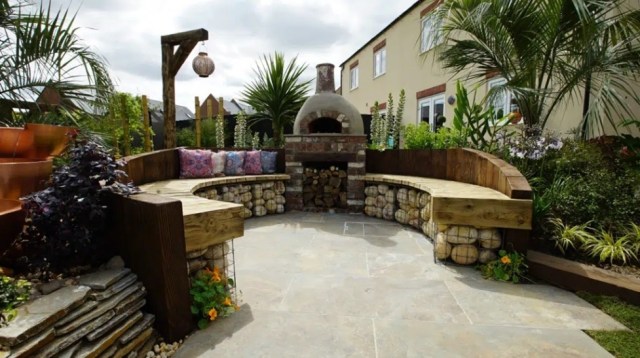
Here though, these gabions have been used (on an episode of ITV’s Love Your Garden) to not only add support to the curved, wooden beams for people to sit on, but also to add visual interest with those large boulders beneath drawing the eye to the central area. What a cracking outdoor space that is for cooking and chilling, I could see myself sat there on a warm night with a beer!

Check out this cooking space, I love the food prep worktop sat on top of the wire cages, creating the top tier of outdoor kitchens!
“Why should you choose gabions?”
Firstly, they are exceptionally versatile, and you can be incredibly creative with them, due to the variability of the cage dimensions and the materials you can put inside them. It does not simply have to be a metal basket with stone inside, they can be made into walls, benches and even planters.
As well as this they are far more durable than brick and mortar walls, capable of lasting up to 100 years. Whereas cement can break down over time, due to rain and cold, then needing to be re-pointed, gabions require little upkeep & maintenance due to them being composed of boulders and metal, making them a cost-effective option too.


Arguably, their greatest asset is their sustainability, studies have shown that they have an 80% lower carbon footprint than concrete. Steel that is used for the wire baskets is completely recycled, with steel being the most recycled material used today. The stones used inside them, usually locally sourced, will of course return to the earth once used, I mean where else would they go! Gabions also allow water to move through them, due to the gaps and spaces between rocks acting as a natural filter, capturing pollutants and debris. This in turn improves water quality, which again benefits wildlife, allowing plants to grow and species to move through.
“How can gabions help wildlife?”
Being a wildlife gardener, I’m particularly interested in how hard landscaping can be beneficial. Gabions provide great micro-habitats for wildlife due to the spaces between the stones inside providing lots of little nooks for small plants to grow & creatures to shelter. In the images below you can see where a Labyrinth Spider has formed its conical web between stones in this gabion. They are literally a ‘living wall’.


With a few adjustments they can be constructed with wildlife in mind, for instance by adding thin pipes you can provide a habitat for solitary bees, in that sense they’re kind of like a large bug hotel. In our garden we’ve added numerous small pipes to various structures, most of which are now home to Leaf Cutter Bees which lay their eggs inside the tubes and block them with chewed up leaves. As well as this, by installing a tunnel from one side to the other, hedgehogs, rodents & amphibians will have a ‘highway’ to travel through.


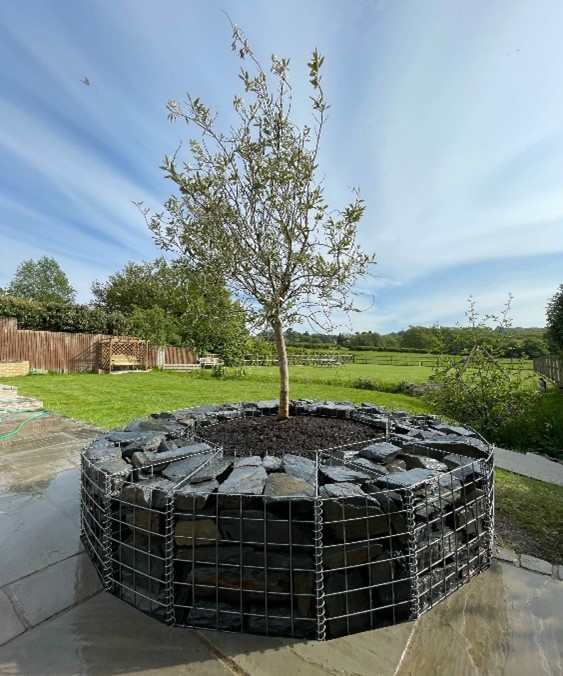
Another way you can easily use gabions to encourage wildlife into your garden is to use them as a planter (as seen above). In this next example we can see gabions containing slate, acting as a container for this willow tree. Just like with a planter made of wood or bricks you can make a raised bed using gabions which you can then fill with super wildlife friendly plants such as Salvia, Aubretia, Michaelmas Daisyand Verbena (all these are suitable for well-drained soil in a sunny spot). Information for purchasing a gabion planter can be found in this link.

And if you’re feeling super creative you could use gabions to create a water feature or a small raised wildlife pond, by lining it with a water tight container/liner, and filling it with small pond plants such as Marsh Marigold and Water Forget-me-not. (Just make sure to create a slope running up the gabion using logs and stones so creatures can get in and out!).
“What other plants could I use in a gabion?”
One group of plant you could easily utilise inside gabions would be climbers. Ivy is an incredibly hardy, fast growing, native climber that is fantastic for wildlife which can easily grow around the metal mesh of the containers providing flowers and berries for Autumn into the Winter. Another wildlife friendly climber is Climbing Honeysuckle, this should be planted in the ground on the shady side of a gabion allowing its stems to climb up the mesh towards sunlight. It produces beautifully scented flowers in the Summer which are perfect for moths. As well as these Sempervivum would be a brilliant ornamental addition to a wall gabion due to its hardy, drought resistant nature and roseate of leaves. Other drought resistant alpines can also be planted between stones, with a little soil such as Sedum & Armeria.
For me, it seems gabions really are an untapped resource for adding necessary structure to your garden and a wildlife friendly haven in a small space. Both durability of gabions and their creative flexibility is really underappreciated. To find out more about the numerous different types of gabions and the different sizes and dimensions you can purchase, please follow the link to Wire Fence.

Thank you for reading!


 Green Fingered George
Something that has never entered my head, but plenty of food for thought here. What alot of great ideas. Very, very interesting.
LikeLike
This is a really interesting read. I love the idea of using gabions to create a water feature. I think they bring a contemporary look to a garden space. If only I had the room! Great blog 👍🏻
LikeLike
This is a great read with some fantastic ideas for planters and water features, great blog thanks
LikeLike
I’ve never really thought about gabions being used for anything but erosion control, but now I’ll be looking at them very differently. Thanks for writing this and raising awareness about their benefits to attracting more wildlife in your garden. Love the idea of them being used to create outdoor kitchens, a really attractive, cheap and sustainable approach – win, win!
LikeLike
fascinating George, saw a lot of these used in Greece. Definitely think of them a little differently now. All the best for next year at Uni. Have a great Summer.
LikeLike
Thank you so much for your insightful article! I really appreciated how you clearly illustrated the many wildlife benefits—those stone-filled gazebos turned micro‑habitats for spiders, the thoughtfully added bamboo tubes for solitary bees, and the hedgehog tunnels weaving through your gabion structure. Your passion for wildlife gardening shines through and has truly inspired me to consider gabions as living, breathing elements in my own garden.
LikeLike